Connecting Through Knowledge: International Students Explore Rural Futures in the Digital Era at the 7th Summer Course SKPM (2026)
Connecting Through Knowledge: International Students Explore Rural Futures in the Digital Era at the 7th Summer Course SKPM (2026)
 SKPM IPB University
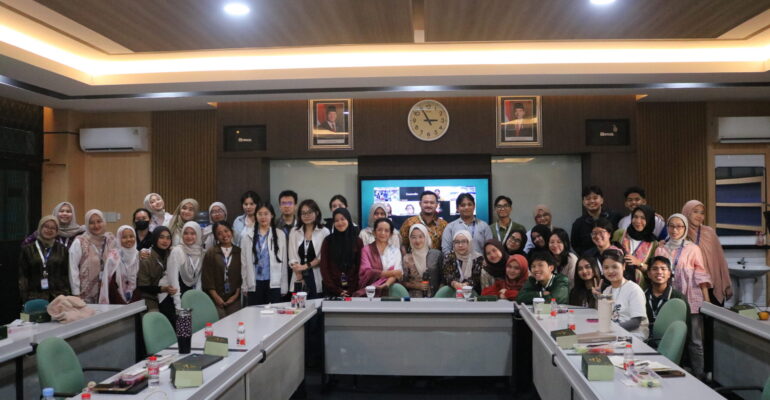
Bogor, 31 July 2026 – Following the three-days Self-Paced Learning stage, the 7th SKPM International Summer Course 2026 continued its Hybrid Class Session on 27–31 July 2026. The hybrid session brought together 40 participants (22 international and 18 Indonesian students) in an interactive learning environment through offline and virtual meetings.
The international participants came from across Asia, such as Malaysia, Japan, China, Thailand, and the Philippines. Thus, creating a diverse classroom where rural development and community issues could lead to discussions from different backgrounds and perspectives.
The five-day academic session featured lectures, discussions, practical sessions, individual and group reflections, and preparation for the field visit and collaborative project. Through a session delivered by Dr. Ir. Melani Abdulkadir-Sunito, M.Sc., the participants were introduced to the central theme of “Connecting Communities for Sustainable Rural Futures in the Digital Era.”
The academic program was also enriched by seven international speakers representing leading universities and institutions, including Universiti Putra Malaysia, The University of Queensland, China Agricultural University, Kasetsart University, the University of the Philippines Los Baños, ICRAF, and DDP (Data Desa Presisi).
Among the topics discussed were Rural Communication, Participatory Communication and Agricultural Extension, Rural Development and Sustainable Agriculture, Community-Based Agricultural Innovation, Community Development Practices in the Philippines, Integrated Landscape Management for Sustainable Development, and Data Desa Presisi as a Participatory Mapping Method.
While the enthusiasm was evident throughout the sessions, the participants actively asked questions, shared experiences from their home countries, and engaged in discussions with lecturers and fellow participants. This process encouraged cross-country comparison and allowed participants to recognize both similarities and differences in rural development, communication, agriculture, environmental governance, and community development across contexts.
Rather than relying solely on classroom lectures, participants were also involved in practical sessions designed to connect academic concepts with real-world situations. The sessions encouraged participants to apply the ideas they had learned and reflect on challenges faced by communities in their respective countries.
An important component of the learning process was the Individual Reflection and Group Reflection. Participants were asked to identify and analyze development-related problems in their respective country based on the topic discussed each day. They also compared these issues with the experiences and conditions of participants from other countries as part of the reflection.
The Hybrid Class Session then concluded with preparation for the on-site study and collaborative project, including a campus tour at IPB University and a preliminary field visit to Merdesa. These activities prepared participants to move from classroom-based learning toward direct engagement with communities.
Through the Hybrid Class Session, the Summer Course provided more than academic knowledge. It created a space where students could learn from different perspectives, exchange experiences across borders, and build the foundation for meaningful collaboration in the field.